Most advice about building a personal brand on LinkedIn is garbage.
Post consistently. Be authentic. Provide value. Share your journey.
Great. Super helpful. Thanks for that.
Here's what they don't tell you: building a personal brand isn't the goal. Getting clients is the goal. Your personal brand is just the vehicle.
I see founders spending hours crafting the perfect post, optimizing their profile photo, and agonizing over their headline. Meanwhile, they have zero clients from LinkedIn and don't understand why.
The problem isn't execution. It's strategy.
They're building a personal brand in a vacuum, disconnected from actually generating revenue. They're optimizing for likes and followers instead of conversations and customers.
Let me show you what actually works.
The Personal Brand Paradox
Here's the thing nobody tells you: the best personal brands don't feel like brands at all.
When you see someone on LinkedIn who has a massive following and seems to effortlessly attract clients, it doesn't feel like they're "doing personal branding." It feels like they're just being themselves and sharing useful stuff.
That's not an accident. That's the whole point.
The founders who win on LinkedIn aren't trying to build a personal brand. They're trying to help people, share what they're learning, and be genuinely useful. The personal brand is a byproduct.
I learned this the hard way. For months, I was trying to "build my personal brand." I'd craft these polished posts about leadership and innovation and all this abstract bullshit that sounded impressive but said nothing.
Nobody cared. Nobody engaged. Nobody reached out.
Then I started sharing the real stuff. The mistakes I made. The actual numbers from my business. The specific tactics that were working or failing. The vulnerable, messy, unpolished reality of building a company.
That's when people started paying attention. That's when the DMs started coming in. That's when I started closing clients from LinkedIn.
The lesson: stop trying to build a brand. Start trying to be useful and authentic. The brand builds itself.
Why Most Personal Brands Don't Generate Clients
I see the same pattern over and over.
A founder builds a decent following on LinkedIn. They post regularly. Their content gets engagement. They have 5,000 followers, maybe 10,000.
But they're not closing clients from it.
Why?
Because they're optimizing for the wrong metrics. They're creating content that's interesting but not converting. They're building an audience that likes their posts but doesn't buy their product.
Here's the uncomfortable truth: if your personal brand isn't generating clients, it's because one of three things is broken.
First, you're attracting the wrong audience. Your content is too broad or too vague, so you're getting random followers instead of your ideal customers. Someone who sells to enterprise CTOs can't build a following of solopreneurs and expect it to convert. Obvious, right? But look at most people's content and that's exactly what they're doing.
Second, you're not building trust. People follow you, they see your posts, but they don't actually trust you enough to buy from you. Why? Because you're not showing them anything real. You're sharing surface-level insights and generic advice that anyone could google. There's no depth, no proof, no reason to believe you actually know what you're talking about.
Third, you're not creating conversion moments. Your content exists in isolation. You post, people engage, and then... nothing. There's no call to action. No way for interested people to take the next step. No bridge between "this person shares interesting content" and "I should talk to them about working together."
Fix these three things and your personal brand starts generating actual pipeline.
The Foundation: Be Uncomfortably Specific About Who You Help
The biggest mistake I see is founders trying to be relevant to everyone.
They write content that "all SaaS founders" or "any marketer" or "business leaders" could find useful. And because it's for everyone, it resonates with no one.
Your personal brand needs to be built for one specific person. Not a segment. Not a demographic. One actual human being.
When I figured this out, everything changed.
I stopped writing for "SaaS founders" and started writing specifically for bootstrapped B2B SaaS founders doing $0-100K MRR who were struggling with consistent LinkedIn presence and couldn't afford agencies.
That's so specific it feels uncomfortable. You worry you're cutting out too many people. You worry you're limiting your addressable market.
But here's what actually happens: the people who fit that description read your content and think "holy shit, this person is talking directly to me." And everyone else scrolls past, which is fine because they weren't going to buy anyway.
When you nail this specificity, your content becomes magnetic to the right people and invisible to everyone else. That's exactly what you want.
Here's how to get there.
Think about your best customer. Not your ideal fantasy customer. Your actual best customer who's already paid you money and gotten great results.
What's their job title? What size company do they work at? What stage are they at? What specific problem were they dealing with when they decided to buy from you?
Now write all your content as if you're talking to that one person. Use their language. Address their specific pain points. Reference the situations they're actually in.
This is the foundation everything else is built on. Get this wrong and nothing else matters.
The Content Strategy That Actually Converts
Most people approach LinkedIn content backwards.
They think: what would be interesting to post? What would get likes? What would make me look smart?
Wrong questions.
The right question is: what would move someone from "I don't know this person" to "I trust this person enough to have a conversation with them"?
That's a completely different type of content.
Content that converts does three things: it demonstrates expertise, it builds trust, and it creates urgency.
Demonstrating expertise doesn't mean pontificating about industry trends or sharing generic best practices everyone already knows. It means showing receipts. Sharing specific examples. Getting into the weeds of how something actually works.
When I share exact numbers from our business - "we went from 8% churn to 3% in two months and here's the one change that did it" - that demonstrates expertise way better than "here are 7 ways to reduce churn."
When I share the specific DM template that gets 30-40% response rates, complete with examples, that's more valuable than "personalization is important in outreach."
When I post screenshots of actual results, customer wins, or even failures, that's proof I'm not just theorizing.
Building trust comes from vulnerability and consistency.
Share the stuff that didn't work. Talk about the money you wasted. Admit when you were wrong about something. People trust you more when you're willing to show the messy reality, not just the highlight reel.
And show up consistently. Trust isn't built from one viral post. It's built from seeing someone show up week after week, sharing useful stuff, being helpful in comments, actually engaging in real conversations.
Creating urgency is the part most people miss entirely.
Your content can't just be interesting. It needs to make people realize they have a problem that needs solving now, not someday.
When I write about how much time founders waste on manual LinkedIn work, I'm not just sharing information. I'm making people realize "shit, that's me right now, I need to fix this."
When I share a customer story about someone who went from invisible to closing deals from LinkedIn in 90 days, I'm showing what's possible and making people want that outcome.
When I talk about intent signals and how you're missing opportunities every day by not monitoring them, I'm creating FOMO.
This isn't manipulation. It's just being clear about the cost of inaction and the benefit of action.
The Three Content Pillars That Build Trust at Scale
You can't just post random thoughts and expect to build a personal brand that converts. You need a framework.
I organize everything into three content pillars, and I rotate through them. This ensures I'm consistently hitting all the notes that move people from awareness to trust to action.
Pillar 1: Build in Public
This is where you share real numbers, real lessons, real failures. The more specific and vulnerable, the better.
"We just hit $15K MRR. Here's the exact breakdown: 65% from LinkedIn, 25% from word of mouth, 10% from content. What worked: posting 5x/week consistently, engaging daily, and reaching out to 20-30 high-intent prospects weekly. What didn't work: trying to automate too early before we understood what actually resonated."
That post does multiple things at once. It shows proof (we're a real business with real revenue). It demonstrates the strategy (here's what's working). It shows authenticity (here's what didn't work). And it gives people a framework they can apply.
Building in public isn't about showing off. It's about pulling back the curtain so people can see how the sausage gets made. When you do this consistently, you become the obvious choice when someone needs help with what you do.
Pillar 2: Insights and Opinions
This is where you have a point of view about your industry. Not safe, agreeable takes everyone already believes. Actual opinions that some people will disagree with.
"Everyone says 'content is king.' I think that's bullshit. Distribution is king. Content is just the kingdom. I've seen founders spend 20 hours crafting the perfect blog post that gets 50 views because they have no distribution strategy. Meanwhile, someone else repurposes a decent post across LinkedIn, Reddit, and email and gets 10,000 views. Same effort, 200x the result."
Strong opinions do two things. First, they position you as someone who actually thinks critically about your space instead of regurgitating common wisdom. Second, they attract your people and repel everyone else.
Some people will read that and think "yes, exactly!" Those are your people. Some people will disagree and argue in the comments. That's fine - engagement is engagement, and the algorithm loves controversy. And some people will just move on. Perfect.
You don't want to be for everyone. You want to be unmistakably for your people.
Pillar 3: Customer Stories and Social Proof
This is where you show, not tell.
Instead of saying "our product helps founders save time on LinkedIn," I share actual customer stories.
"One of our customers went from spending 10 hours a week on LinkedIn to 45 minutes. Same results - still posting 5x/week, still getting 20+ qualified conversations per month. The difference: he stopped manually doing everything and started using Ghost to handle the repetitive parts. His exact words: 'I got my weekends back without sacrificing growth.' That's the whole point."
Notice I'm not pitching. I'm telling a story. But that story does all the work a pitch would do - it shows the before state (10 hours/week), the after state (45 minutes/week), the outcome (same results), and the transformation (got weekends back).
Customer stories are the most powerful form of social proof because they're specific and relatable. When someone reads that and thinks "that's exactly my situation," they're already 80% of the way to reaching out.
Rotate through these three pillars and you're consistently demonstrating expertise, building trust, and creating urgency. That's the trifecta.
Why Engagement Matters More Than Posting
Here's something that took me way too long to figure out: commenting on other people's content is more valuable than creating your own.
I know that sounds backwards. But hear me out.
When you post, you're hoping people see your content in their feed. Maybe they do, maybe they don't, depending on the algorithm. Your reach is limited to your followers plus whoever happens to see it through shares.
When you comment on someone else's post - especially someone with a bigger audience than you - your comment shows up in the feed of everyone who engages with that post. You're borrowing their audience.
If someone with 50K followers posts something that gets 500 comments, and you leave one of the first thoughtful comments, your comment potentially reaches tens of thousands of people.
And here's the key difference: when people see your comment, they're not just seeing your content. They're seeing you demonstrating expertise in real-time, in the context of someone else's post. That's way more credible than self-promotion.
Think about it. If I post "here's how to get better response rates on LinkedIn DMs," you might read it, you might not. But if I leave a thoughtful comment on a popular post about LinkedIn outreach, sharing a specific example from my experience and a nuanced take that adds to the conversation, people click through to see who I am.
That's how I grew my following faster than posting ever did.
The strategy is simple but powerful.
Identify 10-20 people in your space who post regularly and get good engagement. Not mega-influencers with millions of followers, but people with 10K-100K who are active and responsive.
Turn on post notifications for them so you know when they post. And make it a daily habit: spend 15-20 minutes leaving thoughtful comments on 5-10 posts.
Not "great post!" or "thanks for sharing!" Those are worthless.
Leave comments that add something to the conversation. Share a related example from your experience. Ask a thoughtful question that extends the discussion. Politely disagree with a specific point and explain why.
Two to four sentences. Long enough to add value, short enough that people will actually read it.
Do this consistently for a few weeks and watch what happens. Those influencers start recognizing your name. They engage with your comments. Sometimes they share your posts. Their audiences start seeing you everywhere and clicking through to check you out.
And unlike posting, which can feel like shouting into the void, commenting is an actual conversation. It's how you build real relationships on the platform, which is ultimately what turns into clients.
The Conversion Mechanism Most People Miss
Your personal brand can generate tons of awareness and still not produce clients if you don't have conversion mechanisms built in.
A conversion mechanism is anything that moves someone from "I follow this person" to "I'm talking to this person about working together."
Most founders don't think about this. They post content, they build a following, and they just hope people will DM them. Some do, but most don't. You're leaving money on the table.
Here's what actually works.
First, your profile needs to convert. When someone sees your comment or your post and clicks through to your profile, what happens? If your headline just says "Founder at Grow with Ghost" and your About section is a boring resume, they're gone.
Your headline should clearly say who you help and what outcome you deliver. Your About section should tell a quick story that ends with a clear call to action.
I use something like: "I help bootstrapped B2B SaaS founders generate 20+ qualified leads per month from LinkedIn - without ads or agencies. Started from zero two years ago, now LinkedIn drives 60% of our revenue. If you're trying to make LinkedIn work without burning out, follow me for the playbook. Or try Ghost: [link]."
That's specific, it shows proof, and it has a clear next step.
Second, you need to create conversion moments in your content. Not every post, but regularly.
When I share a customer story, I end with "If you're dealing with [same problem], here's how we approach it: [link to case study or demo]."
When I share a framework or tactic, I end with "Want the full playbook? Grab it here: [link to lead magnet]."
When I share a win or milestone, I end with "We help [ICP] achieve [outcome]. If that's you, let's talk: [DM me or book a call]."
These aren't pushy. They're just clear invitations for people who are interested to take the next step.
Third, you need to proactively reach out to people who show intent. Your personal brand creates signal, but you still need to act on it.
When someone engages consistently with your content - commenting, liking, sharing - they're raising their hand. That's your cue to DM them.
"Hey Baz Furby, noticed you've been engaging with my posts about [topic] - appreciate it! Quick question: is [problem you solve] something you're actively working on, or more back-burner for now? Either way is cool, just want to make sure I'm not spamming you with content if it's not relevant."
That's not salesy. It's just acknowledging their interest and offering to help if they want it.
The combination of these three things - optimized profile, conversion moments in content, and proactive outreach to engaged followers - turns your personal brand from awareness into actual pipeline.
The Weekly Rhythm That Makes This Sustainable
Here's the reality: if building your personal brand takes 10 hours a week, you won't do it consistently. And consistency is the only thing that actually matters.
The system I've landed on takes about 30 minutes a day, and it's sustainable even when I'm busy with everything else in the business.
Monday morning, I spend 30 minutes planning the week. I look at what performed well last week - which posts got real engagement, which comments sparked conversations, which DMs got responses. Then I plan 3-5 content topics for the week based on what's working.
I also identify 5-10 high-intent prospects to reach out to. People who just changed jobs, people who are actively engaging with content about the problem I solve, people who asked questions in comments that signal they're looking for solutions.
Tuesday through Friday, the routine is the same. I post one piece of content (pre-written or quickly drafted based on Monday's plan). I spend 15 minutes engaging - leaving thoughtful comments on posts from my target list of influencers. And I send 3-5 personalized DMs to people on my outbound list.
Total time: 30-45 minutes per day.
That's sustainable. I can do that even on my busiest days. And because it's sustainable, I actually do it consistently, which is how you build a personal brand that compounds.
The first month, you're building momentum. You're figuring out what resonates. You're starting to get recognized in your niche.
The second and third months, things start clicking. Your content is getting more traction. People are starting to recognize your name. You're having real conversations.
By month six, if you've been consistent, your personal brand is working. You're getting regular inbound. Your content reaches thousands of people. Your network is opening doors.
But you have to get through those first few months where it feels like nothing is happening. That's where most people quit.
The system makes it sustainable so you don't quit before it starts working.
The Metrics That Actually Indicate You're Building a Brand That Converts
Most people track the wrong things.
Follower count doesn't matter if those followers aren't your ideal customers. Likes and impressions don't matter if they're not leading to conversations. Even engagement rate is kind of meaningless if it's not the right people engaging.
Here are the only metrics that actually tell you if your personal brand is working:
Qualified conversations per month. How many people are DMing you or replying to your DMs who are actually in your ICP and potentially interested in working together? This is the number that matters. If you're posting consistently and getting zero qualified conversations, something is broken.
Response rate to your outreach. When you DM someone who's been engaging with your content versus a cold prospect who's never heard of you, what's the difference? If your personal brand is working, people who know you should respond at 2-3x the rate of cold outreach. If they're not, you're not building trust.
"I've been following you" conversations. How often does someone reach out and say "I've been following your content for [weeks/months] and wanted to connect"? This tells you if your content is resonating enough that people are paying attention over time.
Pipeline source. Of your total pipeline, how much is coming directly or indirectly from LinkedIn? Directly means someone found you through your content. Indirectly means someone was referred to you by someone in your LinkedIn network, or they saw your name multiple times before searching for you.
Time to close for LinkedIn leads. Deals that come from your personal brand should close faster because trust is already built. If someone's been following your content for 2 months, the sales cycle is way shorter than cold outbound. If that's not happening, you're attracting the wrong people.
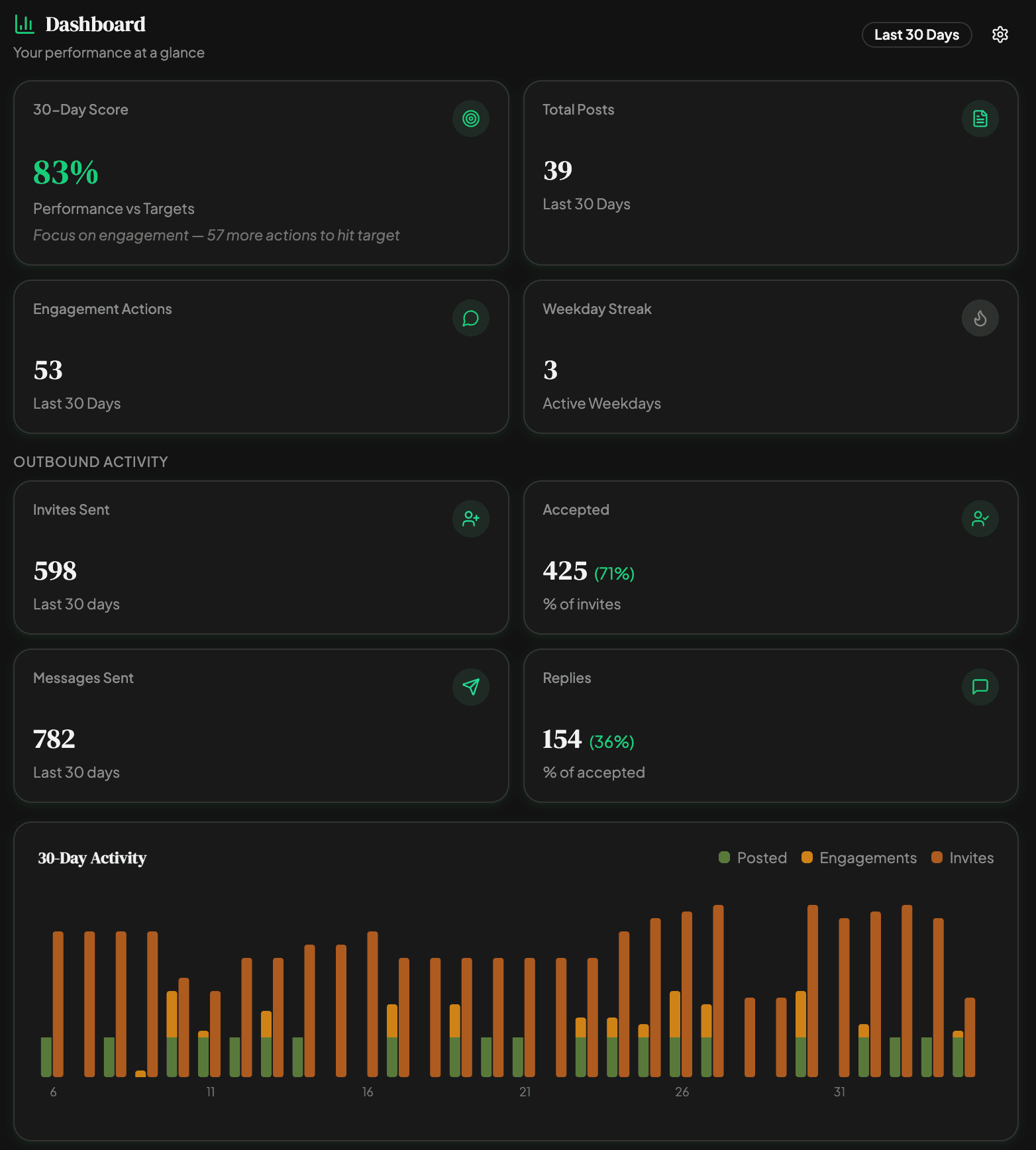
For context, after six months of consistent execution, I was getting 20-30 qualified conversations per month from LinkedIn. My response rate to DMs was around 35% for people who'd engaged with my content versus 15% for cold prospects. About 60% of new demos started with "I've been following your content."
And deals from LinkedIn closed in half the time compared to other channels because the trust was already there.
Those are the numbers that tell you your personal brand is actually working.
The Part Nobody Talks About: It Takes Time
I'm going to be honest with you about something most personal branding advice glosses over.
This doesn't work overnight.
The first month is going to feel like you're screaming into the void. You'll write posts you think are great that get 5 likes. You'll leave thoughtful comments that get ignored. You'll send personalized DMs that go unanswered.
It's demoralizing. This is where most people quit.
Around month 2 or 3, you'll start seeing some signal. A post will actually hit. Someone will DM you asking about your product. You'll have a real conversation with a potential customer who found you through your content.
It feels good, but it doesn't feel like enough yet. You'll question if you're doing this right. You'll see other people's content performing better and wonder what you're missing.
This is where the second wave of people quit.
By month 6, if you stick with it, things start compounding. Your posts consistently get engagement. People recognize your name. You're getting regular inbound. LinkedIn is actually generating pipeline.
This is where it clicks and you realize it was worth the wait.
But here's the truth: most founders never get here because they quit in month 2 or 3.
Building a personal brand that actually generates clients isn't a hack or a shortcut. It's showing up consistently, providing real value, being authentically yourself, and trusting that the compound effect will kick in.
It will. But you have to be patient enough to let it happen.
The Ghost Advantage: Making It Sustainable
I executed this system manually for six months before I finally automated the parts that were killing me.
Writing content from scratch every time. Manually tracking which influencers posted. Searching for intent signals daily. Researching prospects and personalizing every DM individually.
It worked, but I was spending 2-3 hours a day on it. That's not sustainable when you're running a company.
That's why we built Grow with Ghost. Not to replace the personal brand building process, but to handle the grunt work so you can focus on the high-value stuff.
Ghost helps you create content in your voice based on your topics and your past performance. It tracks your target influencers and alerts you when they post so you can comment early. It monitors intent signals and surfaces high-value prospects with context. It helps you personalize DMs at scale without sounding like a robot.
What used to take me 2-3 hours a day now takes 30-45 minutes. Same content quality, same engagement, same pipeline. Just more efficient.
Most AI tools just generate generic posts that sound like everyone else. Ghost is different because it learns your voice, your topics, your ICP. The content it helps you create actually sounds like you.
And it's not just about content. It's the full system - content, engagement, intent tracking, outreach - all in one place.
If you're serious about building a personal brand that generates clients, and you don't want it to consume your entire day, Ghost is built exactly for that.
The Bottom Line
Building a personal brand on LinkedIn that actually gets you clients isn't about going viral or having 100K followers or posting 3x a day.
It's about being uncomfortably specific about who you help. Creating content that demonstrates expertise, builds trust, and creates urgency. Engaging more than you post. Building conversion mechanisms into everything you do. And showing up consistently long enough for the compound effect to kick in.
Do that for 90 days and you'll have a personal brand that generates real pipeline.
Do it for 6 months and LinkedIn will probably be your best acquisition channel.
Do it for a year and you'll wonder why you ever wasted money on anything else.
The system works. The question is whether you'll stick with it long enough to see the results.
And if you want help making it sustainable, that's what Ghost is for.
Or just take the playbook and do it yourself. Either way, you've got this.