The new Ghost website is live. And the backstory is worth sharing — not because it ended well, but because the problem we had is one almost nobody talks about honestly.
Good product. Real users. A growing LinkedIn audience. And a website converting at under 0.1%.
Five thousand visitors a month. Two or three signups. Every single paying customer came from an event, a direct conversation, or a warm referral — never from the site. The website was functionally invisible to the people it was supposed to convert.
The data was obvious. We just didn't want to see it.
We looked at the analytics. We talked to the people who didn't convert. We ran session recordings. And the pattern was consistent once we stopped making excuses for it.
The site was trying to speak to everyone at once.
Founders. Solopreneurs. Sales teams. Marketers. Coaches. All on the same homepage. Four distinct ICPs being addressed in the same breath, with the same value props, the same social proof, the same CTA. The kind of homepage that explains everything and convinces nobody — because when you're speaking to everyone, you're speaking to no one.
Every visitor had to do too much work. They had to figure out if this was for them, why they should care, and what to do next — all before the page had earned the right to ask for anything. Most gave up before they got there.
But that was only half the problem. The positioning itself was broken.
The positioning trap: trying to win two fights at once
Ghost was positioned as both a LinkedIn content tool and an outbound automation tool. Which sounds like a strength — two tools in one — until you realise what it actually means in a market like this.
It means you're competing with Taplio for the content buyer. And with Clay for the outbound buyer. And losing to both — because the content buyer looks at Taplio and sees a tool built entirely for content. The outbound buyer looks at Clay and sees a tool built entirely for outbound. Ghost looked like it was trying to do both things adequately, rather than one thing brilliantly.
You can't out-feature a specialist on their home turf. We were trying to win two category fights simultaneously with half the budget, half the brand awareness, and a positioning statement that sat awkwardly in the middle of both.
The harder question — the one we'd been avoiding — was: why do our actual customers get results?
The reframe that changed everything
Not because Ghost is the best content tool. Not because it's the best outbound tool.
Because it's the only thing that connects the two.
That sounds obvious in hindsight. It always does. But it required us to stop describing what Ghost does and start describing the problem that Ghost solves — a problem that nobody else was naming clearly.
Most LinkedIn GTM is two broken motions running in parallel. You publish content on one track. You send outreach on another. Neither knows what the other is doing.
A prospect engages with your post — likes it, comments on it, clicks through to your profile — and you never find out. That signal disappears into LinkedIn's black box. Meanwhile, you're sending that same prospect a cold DM that lands with zero context, zero timing, zero relevance. You've done twice the work for half the result.
Ghost closes that loop. Every post builds intent signal. Every signal triggers personalised outreach at exactly the right moment — when the prospect is already warm, already engaged, already thinking about the problem you solve. Content and outbound stop being two separate jobs and start being one compounding motion.
That's the thing we weren't saying. That's the thing our customers were experiencing, but we weren't articulating. And once we named it clearly, the entire positioning shifted.
What changed on the new site
Once the positioning was clear, everything else followed quickly.
The ICP narrowed. Founders first. Revenue teams second. Not because we can't serve marketers and coaches — we can — but because diluted positioning is a conversion killer and you earn the right to expand after you own a lane, not before.
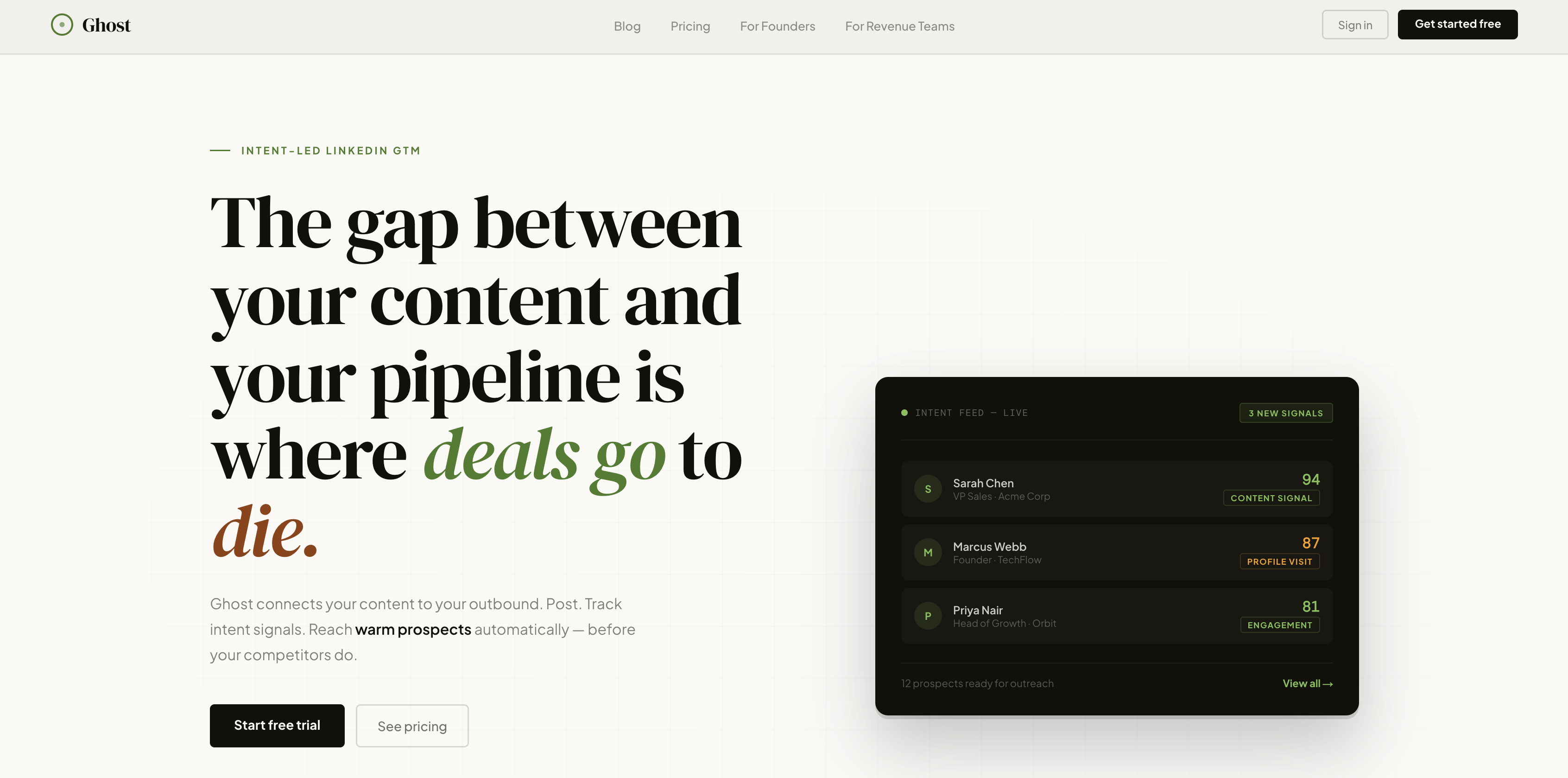
The homepage collapsed from twelve sections to five. We stripped out everything that wasn't doing direct work to build belief in the core idea. No testimonial carousels. No feature grids. No “how it works” diagrams that required the reader to be already convinced before they got there.
The before/after got brutally specific. Not “improve your LinkedIn performance.” Not “generate more pipeline.” The specific pain: you're posting every day, someone engages, you never find out, the deal dies in the gap between your content calendar and your outreach list. That gap has a name now.
And the headline wrote itself:
The gap between your content and your pipeline is where deals go to die.
That line came directly from conversations with the founders who do use Ghost and get results. They all described the same pre-Ghost experience: posting consistently, building an audience, watching the engagement metrics go up — and still not generating consistent pipeline. Not because the content was bad, but because there was no system connecting what they were publishing to who they should be talking to.
The rebuild itself
The old site was built on Webflow. It worked, but the constraints were real — every design change required navigating Webflow's visual editor, every copy change touched multiple components, and the CSS output was a wall of generated class names that made fine-tuning painful.
The new site is a full Next.js rebuild. Statically exported, edge-delivered, clean semantic HTML. We rebuilt every page from scratch: the homepage, the Founders landing page, the Revenue Teams landing page, pricing, blog, and a full set of LinkedIn outreach guides for every major B2B role and industry.
The result loads faster, ranks better, and — most importantly — actually says what we do to the people who need to hear it.
If you're in the same position
The thing nobody tells you about website conversion problems is that they're almost never design problems. They're almost always positioning problems that manifest as design problems.
You look at your homepage and think: this looks fine. The design is clean. The copy isn't embarrassing. Maybe we need a better hero image. Maybe the CTA button colour is wrong.
But the real question is: does this page make a specific person feel immediately understood? Does it name their problem with enough precision that they lean forward instead of bouncing?
If the answer is no — if your homepage is technically fine but functionally invisible — the fix isn't a redesign. It's a repositioning. And the repositioning has to come before anything else.
For us, that meant getting honest about who Ghost is actually for, what problem it actually solves, and what makes it genuinely different from every other tool in the category. Not a crowded category, or a crowded two categories — a distinct position that nobody else occupies.
The new site is live now. Completely rebuilt — structure, copy, design, positioning. If you're posting every day on LinkedIn and still not generating consistent pipeline, the gap between your content and your outreach is probably why. See the new site →